🤖 The Automation Paradox: Why Fewer Workflows Convert More
Or: how to stop flexing your Franken-funnels in Facebook groups.
Let’s talk about the elephant in every GoHighLevel Facebook group:
The guy (you’ve might seen him) proudly posting a screenshot of his 47-step workflow with 12 nested if/else branches, seven “wait 1 hour” delays, and a Google Sheet integration from 2019 that still somehow “runs.”
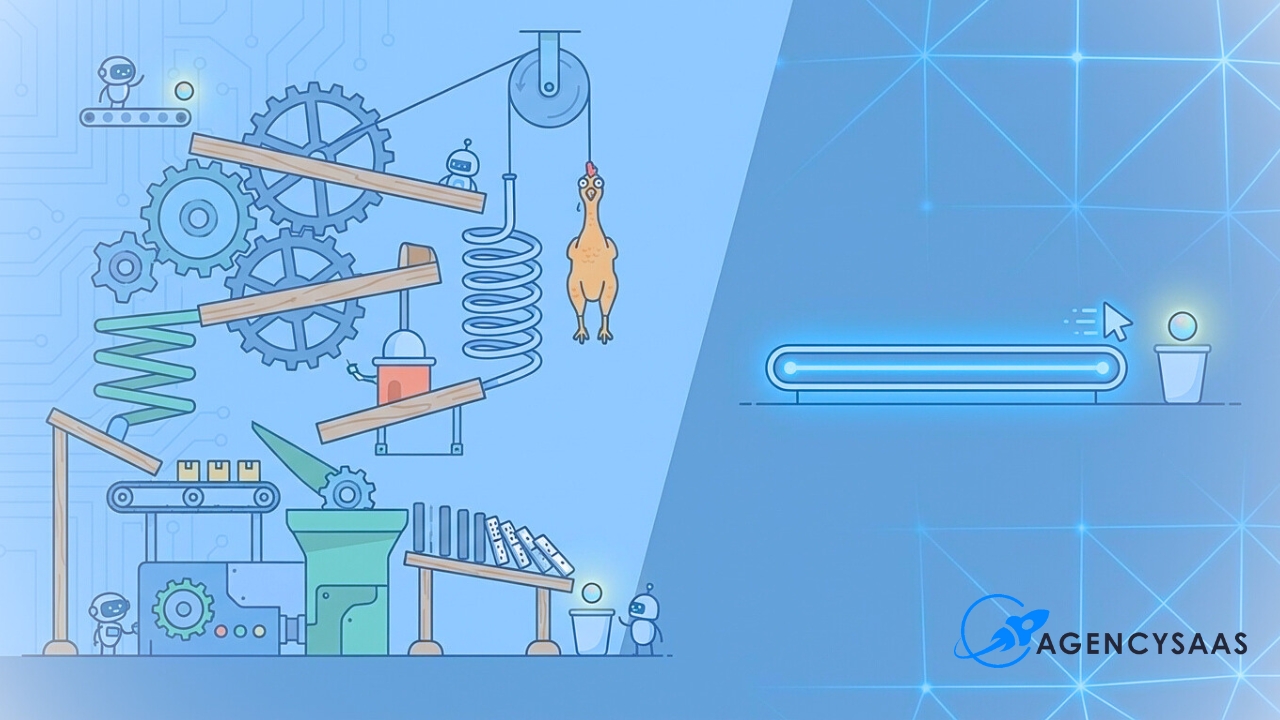
It’s impressive, sure -- in the same way a Rube Goldberg machine that butters toast is impressive.
But here’s the thing: no client ever said,
Wow, this workflow is beautiful -- I’ll definitely renew my subscription.
Nope. They said,
It didn’t work.
Because more automation ≠ more activation.
Below are reasons to unpack why.
🧠 1. The Frankenstein Workflow Problem
When your automations look like a Jackson Pollock painting, you’re not only building systems, but you’re building confusion.
Every time a client says “it’s broken,” you’ll spend 45 minutes inside Workflow #9 trying to remember what Trigger #3 actually does.
Meanwhile, your users? They gave up after step two.
They don’t want complexity. They want certainty.
They want a system that just works. Not a thesis in conditional logic.
⚙️ 2. The “Aha Moment” Rule
Here’s the real test for a SaaS operator:
Can a user experience value in 10 minutes or less?
If not, your workflows are too long, too clever, or both.
Every successful SaaS Mode system I’ve seen has one clear “aha moment.”
It might be:
A missed-call text that replies instantly.
A lead capture form that triggers a same-minute follow-up.
A review request that gets results before the client logs in.
That’s it.
Users don’t need a 12-step omnichannel nurture to feel the win! They just need one visible, instant result.
🧩 3. Complexity Kills Confidence
When users see too many moving parts, they stop trusting the system.
That’s why I tell operators:
If it takes a Loom video longer than 3 minutes to explain your workflow, delete half of it.
Your job isn’t to show off.
It’s to make the “magic” happen fast and quietly.
Keep your setup stupid simple:
1 workflow for leads
1 for reviews
1 for reactivation
1 safety net (missed calls or no-shows)
That simple.
Four. Not forty.
(If you want a reference build, grab the Lean Automation Framework — it’s the no-bloat version every operator should start with.)
💀 4. Over-Automation = Under-Activation
When you build too much, you’re solving imaginary problems.
You add tags to filter tags that apply other tags.
You make triggers that update opportunities that update triggers.
You’re not operating anymore. You’re nesting chaos.
And your users? They never make it past setup.
Because when everything happens automatically, nothing feels like progress.
The irony: the simpler the system, the faster they engage.
The more you automate, the less they believe it works.
💰 5. Keep It Lean, Keep It Lucrative
Complexity doesn’t scale. But clarity does.
A simple SaaS Mode setup takes less time to build, less time to support, and gives you higher activation and lower churn.
That’s profit.
That’s freedom.
And that’s what separates operators from “workflow artists.”
Here’s your operator playbook:
Trim to four workflows max.
Make sure one creates an instant “aha.”
Never brag about your logic map again.
If you catch yourself opening Lucidchart to plan an automation, just stop.
Go outside. Touch grass.
Then come back and simplify it.
🧭 The Takeaway
The next time someone in a GHL group flexes their 89-step “AI Appointment Nurture Funnel of Doom,”
just smile and remember:
You’ll keep your clients longer, not because your system is prettier, but because it’s useful.
That’s the Automation Paradox.
Less doing. More activating.
If you want to see how top operators structure lean SaaS Mode systems that activate in under 10 minutes, check out our Templates Library or hop into our Operator Tactics Newsletter.